Instruments
MUPAS EnviroDot
The field unit. It runs about a day on its own battery, sets up from your phone over Bluetooth, and sends its readings over any Wi-Fi network you have taught it. It goes where the Mini cannot: a cabin, a car, a room with no outlet.
What it records
- Temperature, air pressure and humidity.
- Motion and orientation — an accelerometer and a gyroscope.
- Magnetic field — a magnetometer, three axes.
- Sound level — how loud it is, as a level. Nothing is recorded that could be listened to; the unit keeps no audio.
- RF activity nearby — a relative reading that shows a transmitter close to the unit, such as a phone beside it.
- A particle-radiation channel — beta and alpha particles, as a relative reading, with a reference channel to tell electrical interference from radiation.
For gamma, the GMC-300 Geiger counter plugs into the EnviroDot's USB port and records counts alongside the other readings.
What you see in the portal
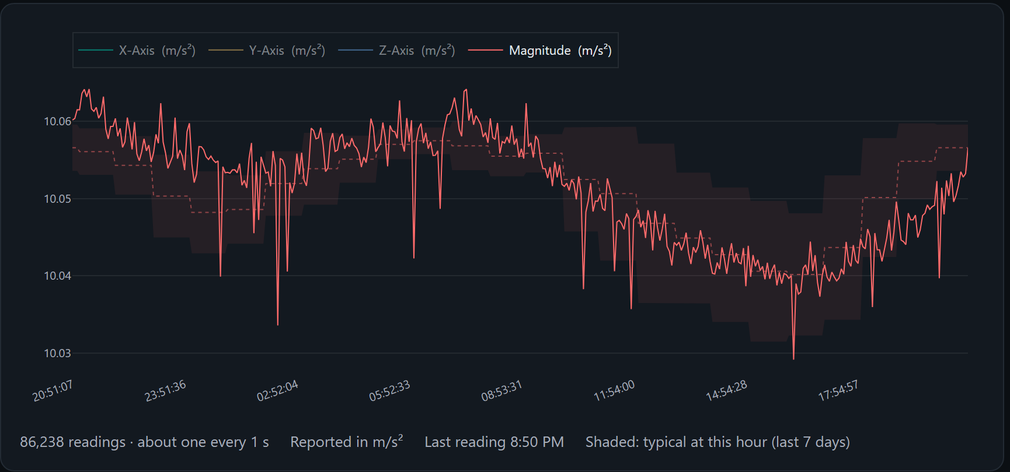
The same charts as the Mini, with the unit's own typical range shaded behind each line.
Setting it up
Charge it over USB-C. Open the MUPAS mobile portal on your phone, pair, and give it a Wi-Fi network; it remembers up to eight, so a unit you carry to another place reconnects on its own. It needs a 2.4 GHz network. Location comes from your phone at setup; the EnviroDot has no GPS of its own.
What it does not do
- It records; it does not tell you what a reading means, and it sends no alarms.
- The RF channel notices transmitters close by. It is not a measure of the RF environment of a room.
- The sound channel reports a level. It does not record sound and cannot play anything back.
- There is no battery gauge on the current units. When the battery runs out it stops. On the charger it runs indefinitely.
- It is not a safety instrument. It records the environment; it cannot tell you whether something is harmful.
Available in the store — $260 · See it in the store
MUPAS™ Worldwide · mupas-worldwide.com · Instruments · How it works · Reading room · Privacy notice